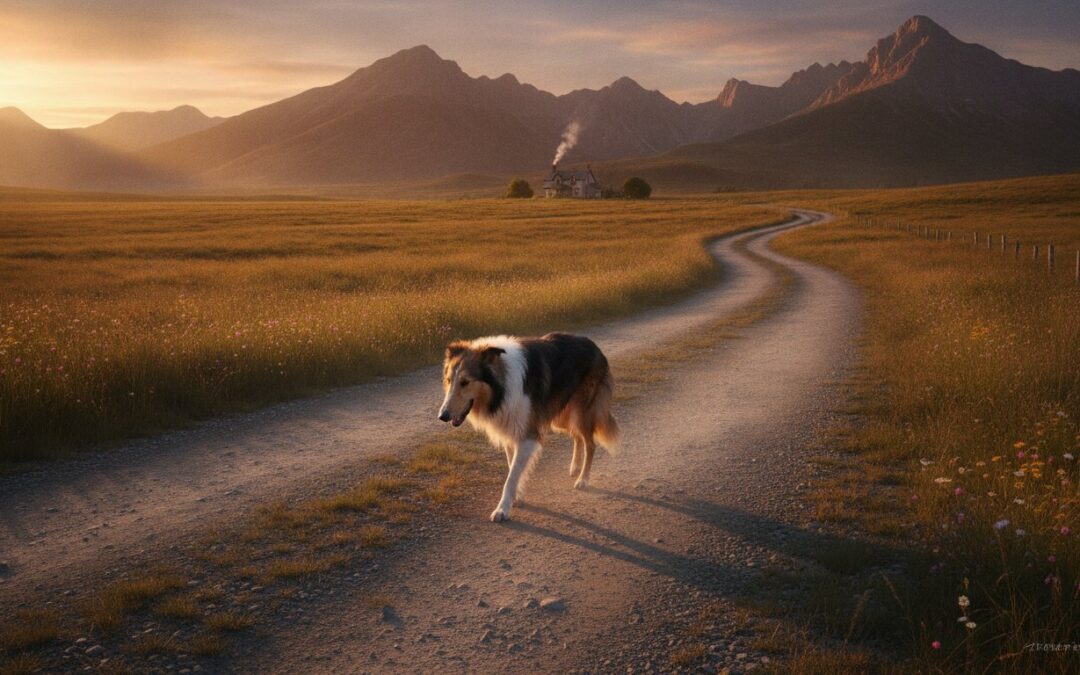
Every so often a story pops up about a dog or cat that turns up on the doorstep years after everyone stopped looking. Most of them are nice but forgettable. A few are so unlikely that I had to read them twice. These are the ones that stuck with me, and I’ve checked each of them against a proper news source rather than just a Facebook post.
Bobbie the Wonder Dog walked 4,100 km home (1923)
This is the one all the others get measured against. In August 1923 Frank and Elizabeth Brazier drove from Silverton, Oregon to visit family in Wolcott, Indiana, with their two year old collie mix, Bobbie. At a petrol stop three local dogs chased him off. The Braziers searched, gave up and drove home without him.
Six months later, in February 1924, Bobbie walked into Silverton. Skinny, feet worn to the bone, but home. The Oregon Humane Society investigated and pieced together his route from people who’d fed him along the way. The best estimate is 2,551 miles, roughly 4,100 km, through a winter that included crossing the Rockies. He got fan mail, medals, his own miniature bungalow and a role playing himself in a silent film. He died in 1927, and the vets reckoned the trip had simply worn him out.
Holly the cat followed the coast for 320 km (2013)
Jacob and Bonnie Richter took their cat Holly on a motorhome trip to Daytona Beach, Florida in November 2012. Fireworks went off, Holly bolted, and after days of searching the Richters drove the 320 km home to West Palm Beach without her.
On New Year’s Eve a woman about 1.5 km from the Richters’ house found a cat in her backyard that could barely stand. Her paws were raw, she’d lost about 3 kg, and the microchip said she was Holly. Nobody knows how she did it. The best theory is she kept the ocean on her left and the highway on her right and just kept going. The New York Times covered it and even the cat behaviour scientists they interviewed admitted they had no real explanation.
Pero the sheepdog quit his new job and walked back to Wales (2016)
This one is my favourite because the dog clearly had opinions. Alan and Shan James run a sheep farm in Ceredigion, Wales. In 2016 they gave their four year old working dog Pero to a farmer in Cockermouth, Cumbria, about 390 km north. Pero lasted a couple of weeks, then took off on 8 April.
Twelve days later Alan walked outside after dinner and Pero was sitting in the yard, spinning in circles and jumping up at him. He’d lost some weight and had a limp, otherwise fine. Nobody knows what route he took, but he’d never been to Cumbria before that trip so he wasn’t retracing his steps. He got to keep his old job.
Clyde the cat went from Tasmania to outback Queensland (about 2010)
An Australian one, and easily the strangest route on the list. Clyde, a fluffy Himalayan cat, went missing from a house near Hobart when he was about a year old. Three years later a nurse found him wandering around the hospital in Cloncurry, in north west Queensland. That’s roughly 3,800 km away, including Bass Strait. He obviously didn’t swim it, so at some point he hitched a ride with someone, but nobody has ever worked out who or how.
The nurse looked after him for four months, then took him to the local vet when she left town. The vet scanned the microchip and rang his owner, Ashleigh Sullivan, who had long given up. A pet transport company flew him back to Hobart for free. Technically he didn’t find his own way home, but I’m counting it.
Valerie the mini dachshund survived 529 days on Kangaroo Island (2025)
The most recent one, and the one that got the most attention here in Australia. Georgia Gardner and Josh Fishlock from Albury were camping on Kangaroo Island in November 2023 when Valerie, a 4 kg sausage dog, ran off. They searched for days, then had to go home without her. Kangaroo Island has snakes, eagles and not much else for a dog that size, so they grieved and moved on.
In February 2025 a farmer photographed a tiny dog running across a paddock. Kangala Wildlife Rescue spent nearly two months trying to trap her. Their cage traps caught possums, feral cats, wallabies and at least one curious kangaroo, but not Valerie. Eventually they built a pen with a remote controlled door, filled it with roast chicken and clothes that smelled like her owners, and waited. She walked in, relaxed, and they dropped the door. After 529 days in the bush she’d actually put on weight. The rescue described her as having the physique of a little bodybuilder.
Nigel the parrot came back after four years speaking Spanish (2014)
Not a distance story, but too good to leave out. Darren Chick, a Brit living in Torrance, California, lost his African grey parrot Nigel in 2010. Nigel had a very proper British accent at the time.
Four years later a local dog groomer found a parrot on her front lawn and it was chattering away in Spanish, asking “¿Qué pasó?” over and over. She traced him back to Darren. It turned out a Guatemalan family had bought Nigel at a garage sale, named him Morgan, and he’d picked up the language from the grandfather. The story has a nice ending too. Darren decided the other family loved him just as much, and gave him back to them.
Manuela the tortoise, missing for 30 years, never actually left the house (2013)
I’ll finish with this one because it’s the opposite of all the others. In 1982 the Almeida family in Rio de Janeiro were renovating their house and their red footed tortoise Manuela disappeared. They assumed she’d wandered off through a door the builders left open.
In 2013, after the father died, the family cleaned out a storeroom that hadn’t been opened in decades. The son carried a box containing an old record player out to the kerb for rubbish collection, and a neighbour asked if he really meant to throw the tortoise out too. Manuela had been living in that box for 30 years. The vet said red footed tortoises are extremely tough and she probably survived on termites and condensation. She’s since been identified as a male and now goes by Manuel. So not so much a case of finding the way home as never having bothered to leave.
What’s the common thread?
Microchips, mostly. Clyde, Holly and Valerie all got home because somebody scanned them. Bobbie and Pero did it the old fashioned way and nobody can properly explain how. Scientists have studied animal navigation for a century and the best they can say is that dogs and cats can probably sense magnetic fields and follow scent over long distances, but a cat working out that “home is 320 km south along the coast” is still a mystery.
The other common thread is that in every case the owners had given up. Which I find oddly comforting. Sometimes the thing you’ve written off is still out there, working its way back.
If you know of an Australian story that belongs on this list, let me know in the comments.