Following on from Jane Caro’s recent piece in the Sydney Morning Herald.
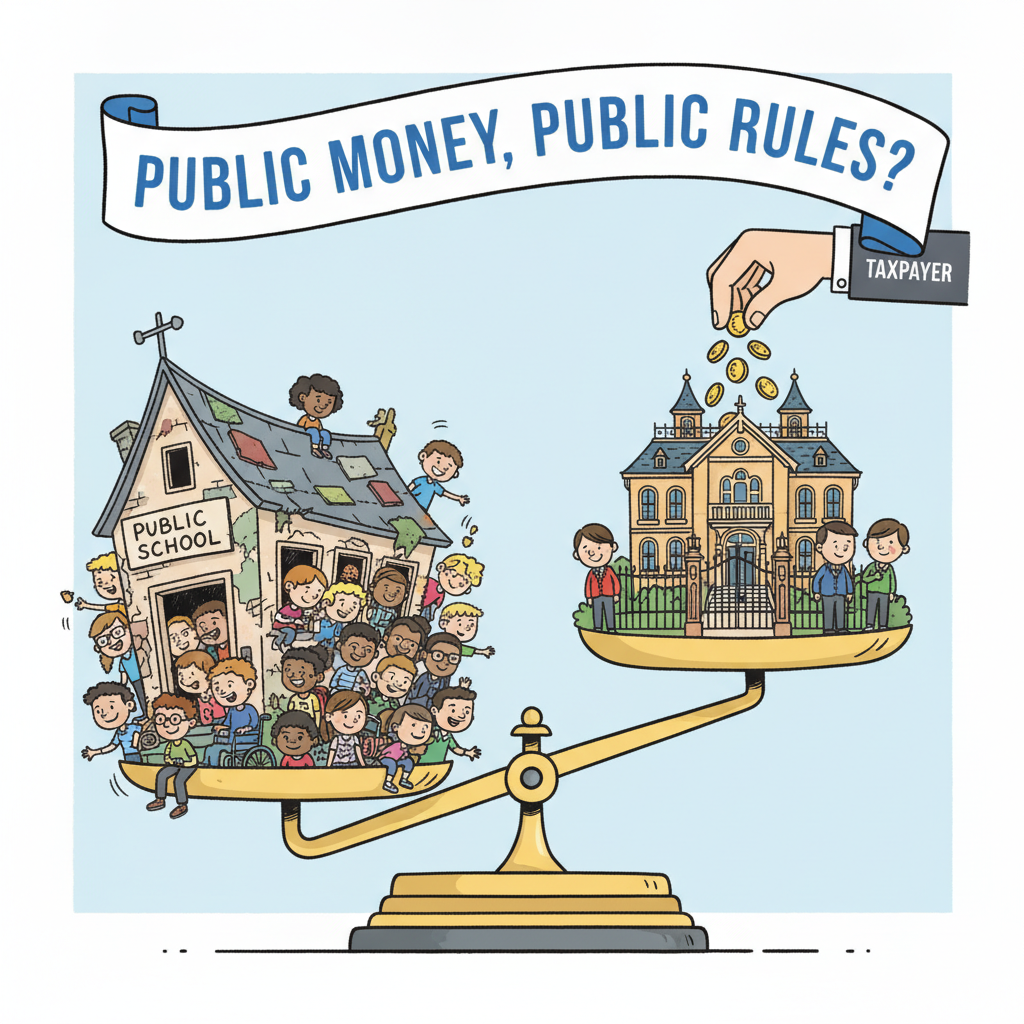
If you’ve followed the school funding debate at all, you’ll know it goes round in circles. Jane Caro wrote a good piece in the Sydney Morning Herald recently laying out just how sorted our schools have become, by wealth, by religion, by postcode. Here’s the part that gets me. We’ve paid for a lot of that sorting with our own tax money. The Commonwealth will spend about $29.1 billion on schools this year, and more than half of it, over $17.8 billion, goes to private schools.1 Public schools, meanwhile, are short by billions.2
So I keep coming back to one simple question. If a private school takes public money, why doesn’t it have to behave like a public school?
That’s the whole idea here. I’m not saying shut private schools down or ban them. I’m saying something a lot smaller. You can take the taxpayer’s dollar, or you can do whatever you like with your fees and your enrolments. You just can’t do both.
So what’s actually broken?
Right now private schools get the good half of the deal and public schools get the hard half. Private schools get public funding, they can pick and choose who they enrol, and nobody checks up on them much. Public schools take every kid who walks in the door, in every situation, and they’re the ones running short on cash.
The numbers back this up. More than half of private schools now get more government funding per student than a comparable public school. The Australian Education Union ran the 2024 figures: on average a private school gets $462 per student above its full Schooling Resource Standard, while a public school comes in $2,509 per student under it. Stretch that out and public schools are looking at a $31.7 billion shortfall between 2024 and 2028.2
Segregation isn’t pretty either. Save Our Schools, using OECD data, puts Australia among the most segregated school systems in the developed world. Around 51% of our disadvantaged kids are bunched together in disadvantaged schools, and the gap has been widening faster here than almost anywhere else.3
None of this is the free market doing its thing. It’s what you get when you pay people to keep the expensive kids out.
Didn’t Gonski sort this out?
You’d think so. This isn’t a new problem, and it’s not like nobody has looked at it. Back in 2010 the federal government asked businessman David Gonski to run the ruler over how we fund schools. His panel spent about 18 months on it, read more than 7,000 submissions, visited 39 schools, and handed down the report in early 2012.8
What did it find? Pretty much what Caro is still writing about now. Australia was putting too little into schools and splitting the money up in a way that wasn’t fair. It found an “unacceptable link” between low achievement and disadvantage, and warned that disadvantaged kids were piling up in the same schools, which drags down results for everyone in them. Kids in poor areas were as much as three years behind kids the same age in wealthy ones.
Gonski’s answer was needs based, sector blind funding. Work out what it actually costs to educate a child, add loadings for the kids who need more help, and send the money where the need is, whether the school is public or private. That’s where the Schooling Resource Standard I keep mentioning comes from. The idea got near enough to unanimous support at the time, from both sides of politics and from the sector.
And then, well, not much. Some extra money went in, but the actual way we hand out funding barely changed. Tom Greenwell and Chris Bonnor called their book on it Waiting for Gonski, which about sums it up. More than a decade on, the segregation Gonski warned about hasn’t eased off. It’s got worse.
So this isn’t me floating some brand new theory. The diagnosis was made years ago and signed off by nearly everyone. We just never took the medicine.
What’s the fix?
Keep it simple. If a private school wants to keep taking public money, it signs up to a few conditions. If it doesn’t like the conditions, fine, it goes fully private and charges whatever the market will bear. Its call.
Here’s what I’d put on the list:
- A cap on fees, somewhere in the $2,000 to $3,000 per student per year range. Public money is there to educate kids, not to prop up a $50,000 a year exclusivity badge. A modest capped fee is reasonable. A fee arms race part funded by everyone else’s taxes isn’t.
- Take a fair share of the harder kids, for free. That means students with disability, kids from poor families, and the ones who cost more to teach. The same kids public schools take every day without blinking.
- No quiet cherry picking. A funded school can’t skim off the cheap, high scoring, easy students and leave the rest for the public system to sort out.
- Teach the national curriculum, hire registered teachers, and show us the books. If it’s public money, we get to see where it goes.
Take the money, take the rules. Don’t want the rules, don’t take the money.
Has anyone actually done this?
Yep, and that’s the best bit. We don’t have to invent any of it. A couple of countries a lot like us already run versions of exactly this.
New Zealand has what it calls state-integrated schools. These are mostly faith schools, about 335 of them teaching around 92,000 kids, roughly 11% of all enrolments, that got folded into the public system. In return for government funding they teach the national curriculum, pay their teachers on the national scale, and take kids from outside their own faith rather than picking freely. And they can’t charge open ended fees. They’re allowed to collect “attendance dues” for the buildings, and even those are capped and can’t go up without the Minister signing off. The proprietors keep their character and their buildings. The public keeps a say over its money.4 That’s basically the deal I’m describing, and New Zealand has been running it for decades.
British Columbia in Canada does a similar thing with a sliding scale. An independent school that plays by the rules, run as a not for profit, staffed by certified teachers, teaching the official curriculum, gets either 50% or 35% of what the local public school gets per student. Spend big above the public benchmark and your funding drops into the lower band.5 The message is pretty blunt. Public money buys a public standard education, not a gold plated one.
Then there’s the option Caro called the Ontario Solution. In Ontario, and across Atlantic Canada, private schools get no government money at all. None. And the private sector there is still growing, more than 160,000 students, all paid for privately.6 Turns out you don’t need to subsidise private schools for them to exist for the people who want them. So that’s the fallback. Any school that reckons the conditions are too much can just fund itself, the Ontario way.
Put those two together and there’s no version left where the public keeps paying and gets nothing for it. New Zealand funds schools and asks for something back. Ontario doesn’t fund them and doesn’t ask. The only deal that makes no sense is the one we’ve got, where we pay up and ask for almost nothing.
But don’t taxpayers get to choose?
This is the objection you hear most, and Caro pulls it apart nicely. The idea is that your tax is a kind of bank account you can dip into to buy whatever service you’d prefer. It isn’t. You don’t get to redirect your slice of the defence budget, and you can’t opt your taxes out of the hospital you never visit. Public money pays for public goods on public terms. A person with no kids still pays for schools, because a country full of educated people is better for everyone, including them.7
The fairness argument is hard to knock too. When the well off families cluster into well resourced private schools, the kids left behind get more concentrated, more disadvantaged, and more expensive to teach. Australian data shows that spiral is already well under way. A fee cap and a fair share rule go straight at the two things driving it, price and picking.
Where does that leave us?
We don’t need to abolish private schools or take away anyone’s choice. We just need to drop the pretence that public money comes with no strings attached. Cap the fees. Share the load of the kids who are hardest to teach. Open the books. Do that and the divide starts closing on its own, because the taxpayer’s dollar finally goes where it was meant to, into educating every kid instead of sorting them into winners and losers.
New Zealand worked this out. British Columbia worked this out. Ontario worked out the other half. The only thing we’re missing here is a politician willing to say it out loud. Public money, public rules.
What do you reckon? Fair deal, or a step too far? Let us know.
References
- The Australia Institute, Federal funding for private schools (Commonwealth 2024 schools spending around $29.1bn total, over $17.8bn to private schools). australiainstitute.org.au
- Australian Education Union, Majority of private schools get more public funding than comparable public schools (2024): private +$462/student above SRS; public $2,509/student under it; public underfunded $31.7bn from 2024 to 2028. aeufederal.org.au
- Save Our Schools Australia, Australia has one of the most socially segregated school systems in the world (OECD PISA data: around 51% of disadvantaged students in disadvantaged schools; among the largest increases in the OECD since 2006). saveourschools.com.au. See also Sciffer et al., Socioeconomic and Indigenous school segregation in Australia, British Educational Research Journal (2026). doi.org/10.1002/berj.70020
- New Zealand Ministry of Education, Financial management for state-integrated schools, and the State-integrated school overview (national curriculum, registered teachers, non preference enrolment, attendance dues capped and needing ministerial approval; around 335 schools, 92,000 students). education.govt.nz and Wikipedia
- Province of British Columbia, Independent school funding (Group 1: 50%; Group 2: 35% of the local public per student operating grant; conditions include not for profit operation, BC certified teachers, and BC curriculum). www2.gov.bc.ca
- Government of Ontario, Private schools (private schools receive no government funding). ontario.ca. On Ontario’s unfunded but growing independent sector (around 160,000 students): troymedia.com
- Jane Caro, Our kids are segregated in so many ways and We should look to Canada for a solution (Sydney Morning Herald); extract from Jane Caro, The Rich Kid, Poor Kid: the battle for public education (Monash University Publishing). See also Tom Greenwell and Chris Bonnor, Waiting for Gonski (2022).
- Australian Government Department of Education, Review of Funding for Schooling: Final Report, December 2011 (the Gonski Review; released 20 February 2012; recommended needs based, sector blind funding via a Schooling Resource Standard; over 7,000 submissions, 39 school visits). education.gov.au. Summary: ABC News, What’s in the Gonski report? abc.net.au